
《台森數碼世界-數位孿森 DTFS.TW 森域名憲章》 雙軸整合(初稿)版
《台森數碼世界-數位孿森 DTFS.TW 森域名憲章》
雙軸整合(初稿) 版 2026/03/07
序 言
在全球數位化與人工智慧快速發展之際,網際網路域名不僅是技術工具,更是 數位主權(Digital Sovereignty) 與網路治理的重要基礎。
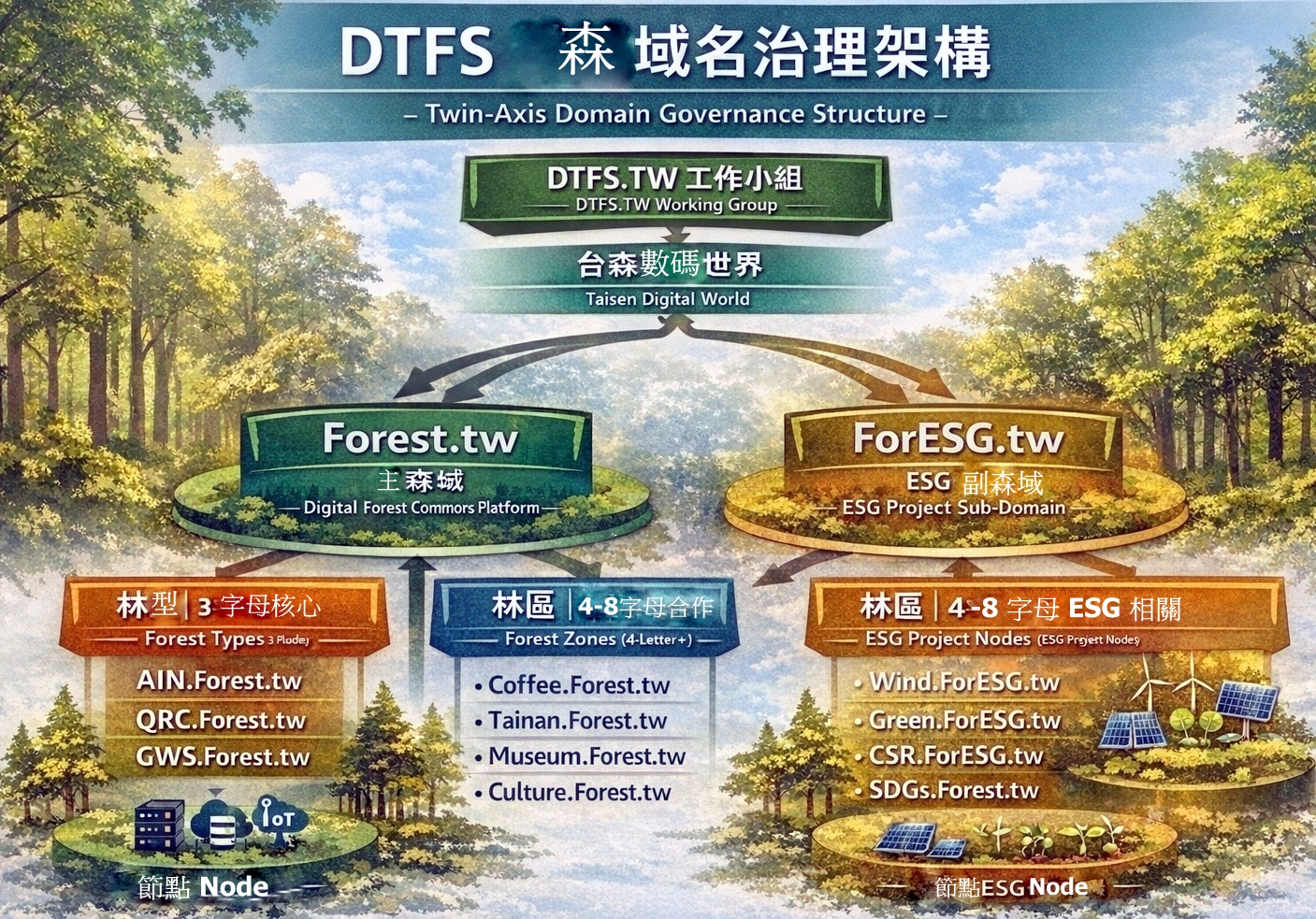
台森數碼世界(Taisen Digital World)基於 數位孿森系統(DTFS, Digital Twin Forest System) 理念,提出以森林結構為隱喻的治理模型,使數位空間形成 主幹、林型、林區與節點 的多層共生結構。
本制度定位為 民間數位森林治理模型(Civic Digital Forest Governance Model),由民間發起與推動,並透過 多元開放合作方式(合作夥伴林區建立、技術平台協作、教育文化推廣、公益與 ESG 專案參與、節點共建等),逐步建立兼具 秩序、彈性與可持續發展 的數位平台架構。
多元開放合作係指透過 合作夥伴林區建立、技術平台協作、教育文化推廣、公益與 ESG 專案參與,以及節點共建等方式,鼓勵不同機構、社群與個人共同參與數位森林之發展,使其形成 多層共生、協同演化 的網路生態。
在此制度架構下:
-
Forest.tw 作為 主森域(Primary Forest Domain),承載制度核心結構與公共平台功能;
-
ForESG.tw 作為 ESG 子軸(ESG Axis),專注於環境、社會與治理相關專案。
本憲章為 DTFS.TW 森域名制度之基本規範文件。
第1條 主森域
Forest.tw 為森域名制度之主森域,所有林型、林區與節點均依附於此核心結構運作。
主森域以 公共平台精神 發展,並鼓勵教育、文化、科技與公益合作。
第2條 雙軸治理
森域名制度採 雙軸治理架構:
-
主軸:Forest.tw
主森域與制度核心平台。 -
副軸:ForESG.tw
專注於 ESG、公益、永續及社會合作專案。
第二章 森林結構
DTFS 森域名制度採三層結構:
Forest.tw│
林型 Forest Type(3字母)
│
林區 Forest Zone(4字母以上)
│
節點 Node(內容 / 服務)
第三章 林型制度
第3條 林型定義
林型(Forest Type)為森域名制度之核心分類單元,以 三字母前綴 表示。
林型具備:
-
系統分類功能
-
簡域名應用
-
編碼制度基礎
第4條 林型功能(制度化委婉版)
-
平時林型 僅限台森數碼世界管理 及制度內部功能使用,對外呈現以三字母識別其專屬性。
-
未來如台森數碼世界 自行開發或與合作夥伴共同建置平台,經 DTFS.TW 工作小組審核,得以三字母林型作為 平台入口或簡網址服務。
-
經工作小組評估與審議,林型可進行 使用權調整或管理權移轉,以符合制度整體發展與公共平台原則。
第四章 林區制度
第5條 林區定義
林區(Forest Zone)為森域名制度之合作空間,以 四字母以上前綴 表示。
-
林區由 經審核之合作夥伴 建立
-
林區 不具交換律
第五章 節點與協槓碼
第6條 節點
節點(Node)為承載內容或服務的單位。
例如:
AIN.Forest.tw/chat
第7條 協槓碼延伸原則
允許在制度內進行 節點與簡網址應用,以支援平台服務、節點識別及系統延伸功能。
註:簡網址之 編碼計畫另行制定,須遵循 DTFS.TW 工作小組審核及制度框架。
第六章 林型管理
第11條 林型管理規範(委婉版)
林型為制度核心資產。
-
平時 僅限台森數碼世界管理 及制度內部功能使用
-
對外呈現以三字母識別其專屬性
-
未來可規劃 協槓碼延伸應用(如簡網址或節點服務)
-
經 DTFS.TW 工作小組評估與審議,林型可進行 使用權調整或管理權移轉,以符合制度整體發展與公共平台原則
第七章 治理機制
第21條 籌備治理機制
在正式治理機構成立前,由 創辦人擔任 DTFS.TW 工作小組籌備召集人,並與 AIN 數位助理系統 協作。
籌備期間可進行:
-
制度研究
-
技術開發
-
林型編碼試辦
-
林區試辦
-
節點與簡網址測試
目的為制度驗證與技術測試,不涉及商業化交易。
第八章 核心制度原則
1. 主森域原則
Forest.tw 為制度核心主森域,所有林型、林區依附於此。
2. 林型稀缺原則
三字母林型為核心資產,集中管理,任何使用權變更均須 工作小組審核。
3. 林區合作原則
四字母以上林區為合作空間,由 審核通過的合作夥伴 建置。
4. 雙軸治理原則
Forest.tw 與 ForESG.tw 形成雙軸治理架構。
5. 協槓碼延伸原則
允許在制度內進行 節點與簡網址應用,編碼計畫另定。
6. 數位森林共生原則
制度以森林生態隱喻,鼓勵多元節點共生。
7. 公共平台原則
Forest.tw 主森域以公共平台精神運作。
8. 長期治理原則
制度資產與使用權調整皆在 公共平台原則與治理規範內 進行。
法律與善意使用聲明(附註)
1. 善意使用原則
本制度內所有林型、林區及節點的運用,均屬 制度內部及善意應用,以推動民間數位森林治理、教育、文化、公益與 ESG 專案為目的。
2. 商標及權利尊重
如使用林型、林區或節點標示可能涉及第三方商標或專有權利,歡迎相關單位提出指教,DTFS.TW 工作小組將配合進行 合理調整或使用權變更。
3. 免責與審核機制
-
所有制度內資源配置、協槓碼或簡網址應用,皆在 工作小組審核與制度規範下進行。
-
制度不作為商業交易或侵權用途之授權保證。
制度創始聲明
台森數碼世界(Taisen Digital World)為 DTFS 數位孿森系統與森域名制度之創始推動者。
Forest.tw 主森域及相關制度,由 DTFS.TW 工作小組籌備推動,秉持 公共治理、民間發起、數位森林共生 原則。
英文版 ( English )
Taisen Digital World DTFS.TW Forest Domain Charter
(Institutionalized and Polite Final Version + Good Faith Usage Statement)
Preface
In an era of rapid digitalization and artificial intelligence development, Internet domain names are not merely technical tools—they are essential foundations for digital sovereignty and Internet governance.
Taisen Digital World, based on the Digital Twin Forest System (DTFS) concept, proposes a governance model inspired by forest structures, organizing digital space into a multi-layered ecosystem of trunks, forest types, forest zones, and nodes.
This system is positioned as a Civic Digital Forest Governance Model, initiated and promoted by civil organizations, and implemented through diverse open collaboration mechanisms (including partner forest zone development, technology platform cooperation, educational and cultural promotion, ESG and public welfare projects, and node co-construction). The goal is to gradually establish a digital platform architecture that is orderly, flexible, and sustainable.
Diverse open collaboration refers to mechanisms such as partner forest zone development, technology platform cooperation, educational and cultural promotion, ESG and public welfare projects, and node co-construction, encouraging institutions, communities, and individuals to participate in the digital forest’s growth and form a multi-layered, collaborative, and co-evolving network ecosystem.
Within this framework:
-
Forest.tw serves as the primary forest domain, hosting the core structure and public platform functions;
-
ForESG.tw acts as a sub-axis focused on ESG, addressing environmental, social, and governance initiatives.
This charter serves as the basic normative document of the DTFS.TW forest domain system.
Chapter 1: Basic Structure
Article 1: Primary Forest Domain
Forest.tw is the main domain of the forest naming system. All forest types, forest zones, and nodes operate under this core structure.
The primary forest domain is developed as a public platform, supporting education, culture, technology, and public welfare cooperation.
Article 2: Dual-Axis Governance
The forest domain system adopts a dual-axis governance structure:
-
Main Axis: Forest.tw
Serves as the primary forest domain and the system's core platform. -
Secondary Axis: ForESG.tw
Focuses on ESG, public welfare, sustainability, and social collaboration projects.
Chapter 2: Forest Structure
The DTFS forest domain system adopts a three-tiered structure:
Forest.tw
│
Forest Type (3-letter code)
│
Forest Zone (4+ letter code)
│
Node (Content / Service)
Chapter 3: Forest Type System
Article 3: Definition of Forest Type
A forest type is a core classification unit of the system, represented by a three-letter prefix.
Functions include:
-
System classification
-
Short domain name application
-
Coding plan foundation
Article 4: Forest Type Functions (Polite Version)
-
Normally, forest types are managed exclusively by Taisen Digital World and used only for internal system functions, publicly represented by the three-letter code to indicate exclusivity.
-
In the future, if Taisen Digital World develops independently or in collaboration with partners, forest types may be used as platform entry points or short domain services, subject to DTFS.TW Working Group approval.
-
Use rights adjustment or management transfer may be conducted after evaluation and deliberation by the Working Group to ensure alignment with the system’s overall development and public platform principles.
Chapter 4: Forest Zone System
Article 5: Definition of Forest Zone
Forest zones are collaborative spaces within the system, represented by four or more letter prefixes.
-
Zones are established by approved partners
-
Forest zones do not possess exchange privileges
Chapter 5: Nodes and Extension Codes
Article 6: Nodes
Nodes are units carrying content or services, e.g.:
AIN.Forest.tw/aiAIN.Forest.tw/chat
Article 7: Extension Code Principles
Within the system, nodes and simplified URLs (shortened URLs) may be used to support platform services, node identification, and system extension functions.
⚠️ Note: Simplified URLs will follow a separately defined coding plan, subject to DTFS.TW Working Group approval and system rules.
Chapter 6: Forest Type Management
Article 11: Forest Type Management (Polite Version)
Forest types are core assets of the system.
-
Normally managed only by Taisen Digital World and used for internal system functions
-
Publicly presented with a three-letter code indicating exclusivity
-
May be used for extension applications (e.g., simplified URLs or nodes)
-
Use rights adjustment or management transfer is subject to DTFS.TW Working Group evaluation and approval to ensure alignment with system development and public platform principles
Chapter 7: Governance Mechanism
Article 21: Preparatory Governance Mechanism
Before the formal governance body is established, the Founder serves as the convening leader of the DTFS.TW Working Group, collaborating with the AIN digital assistant system.
During the preparatory period, activities may include:
-
System research
-
Technical development
-
Trial implementation of forest type coding
-
Trial implementation of forest zones
-
Testing of nodes and simplified URLs
Purpose: system verification and technical testing only; does not involve commercialization.
Chapter 8: Core Principles
1️⃣ Primary Forest Principle
Forest.tw serves as the core primary forest domain; all forest types and zones are attached to it.
2️⃣ Forest Type Scarcity Principle
Three-letter forest types are core assets; any changes in use rights must be approved by the Working Group.
3️⃣ Forest Zone Cooperation Principle
Zones with four or more letters are collaborative spaces, established by approved partners.
4️⃣ Dual-Axis Governance Principle
Forest.tw and ForESG.tw form the dual-axis governance framework.
5️⃣ Extension Code Principle
Nodes and simplified URLs may be used within the system; coding plans are defined separately.
6️⃣ Digital Forest Symbiosis Principle
The system, inspired by forest ecology, encourages multi-node co-existence.
7️⃣ Public Platform Principle
Forest.tw operates under the public platform principle.
8️⃣ Long-Term Governance Principle
System assets and use rights adjustments are conducted within public platform principles and governance norms.
Legal and Good Faith Usage Statement
1️⃣ Good Faith Principle
All uses of forest types, forest zones, and nodes are internal and for good faith purposes, supporting civic digital forest governance, education, culture, public welfare, and ESG projects.
2️⃣ Trademark and Rights Respect
If the use of forest types, zones, or nodes may involve third-party trademarks or proprietary rights, relevant parties are welcome to provide guidance. The DTFS.TW Working Group will cooperate to implement reasonable adjustments or rights transfers.
3️⃣ Disclaimer and Review Mechanism
-
All system resources, extension codes, or simplified URLs are used under Working Group review and system regulations.
-
The system does not guarantee authorization for commercial transactions or infringement purposes.
Founding Statement
Taisen Digital World is the initiator and promoter of the DTFS digital twin forest system and forest domain charter.
Forest.tw and its related systems are implemented by the DTFS.TW Working Group, upholding the principles of public governance, civic initiation, and digital forest symbiosis.